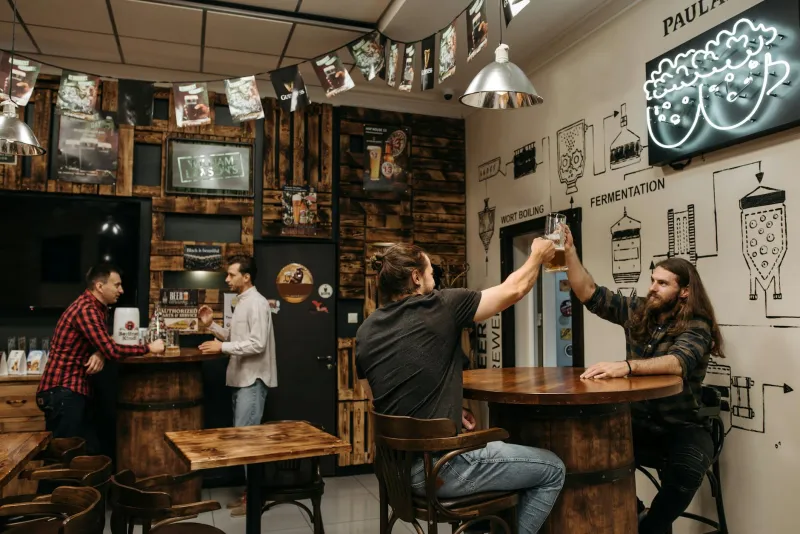
Picture this: it's 1953, and two scientists are hunched over pints of bitter in a Cambridge pub, frantically sketching molecular structures on whatever paper they can find. Those hasty scribbles would eventually reveal the structure of DNA, changing our understanding of life itself. Welcome to Britain's most underrated innovation ecosystem—the humble pub.
The Eagle's Flight: Where DNA Took Wing
The Eagle pub in Cambridge holds a special place in scientific history. It was here that Francis Crick and James Watson would retreat after long days in the laboratory, their minds buzzing with theories about genetic material. The relaxed atmosphere, away from the pressures of formal academia, allowed their ideas to flow as freely as the ale.
On that fateful February day in 1953, Crick burst through the pub's doors and announced to anyone who'd listen that they had "found the secret of life." The double helix structure of DNA, one of the most significant discoveries of the 20th century, was first celebrated not in a lecture hall, but over a celebratory drink.
The Algorithm and the Ale House
Fast-forward to the 1970s, and we find Tim Berners-Lee, the future inventor of the World Wide Web, spending countless evenings in Oxford pubs, discussing information systems with fellow academics. The informal debates and collaborative thinking that flourished in these relaxed environments would later contribute to his revolutionary hypertext concepts.
Similarly, the early days of Britain's fintech revolution can be traced to impromptu meetings in City of London pubs, where bankers and technologists would gather after work to discuss how technology might transform financial services. These casual conversations, lubricated by conversation and camaraderie, laid the groundwork for London's emergence as a global fintech hub.
The Psychology of Pub Innovation
There's genuine science behind why pubs make such fertile ground for breakthrough thinking. Psychologists have long recognised that moderate alcohol consumption can enhance creative problem-solving by reducing inhibitions and allowing for more free-flowing thought processes. But it's not just about the booze—it's about the environment.
Pubs provide what innovation experts call "liminal spaces"—threshold environments that exist between formal and informal, work and leisure, individual and collective thinking. These spaces allow ideas to cross-pollinate in ways that rigid institutional settings often prevent.
From Sketches to Satellites
The tradition continues today. In 2019, a group of engineers from Surrey Satellite Technology were nursing pints in a Guildford pub when they sketched out plans for a revolutionary small satellite design on the back of a beer mat. That design would later become part of a constellation providing internet access to remote regions.
Meanwhile, in Edinburgh's Rose Street, software developers regularly gather in traditional Scottish pubs to discuss artificial intelligence applications. These informal meetups have spawned several successful AI startups, proving that the pub's role as an innovation catalyst remains as relevant as ever.
The Art of Accidental Collaboration
What makes pubs particularly powerful as creative spaces is their democratic nature. Unlike exclusive clubs or formal networking events, pubs bring together people from all walks of life. A conversation that begins between a university researcher and a local tradesperson might spark insights that neither would have reached alone.
This serendipitous mixing is exemplified by the story of James Goodfellow, inventor of the PIN number. His eureka moment came not in a boardroom, but during a casual conversation with a bank manager in a Yorkshire pub in the 1960s. Their discussion about security concerns led to the development of the personal identification system we all use today.
The Modern Taproom Think Tank
Today's craft beer revolution has created new opportunities for innovation. Breweries like London's Kernel Brewery and Manchester's Cloudwater have become informal meeting places for creative professionals. The craft beer community's emphasis on experimentation and quality mirrors the innovative spirit that drives technological advancement.
Some forward-thinking companies have recognised this connection. Google's London offices include pub-style spaces designed to encourage the kind of informal collaboration that traditional meeting rooms stifle. Similarly, several British universities have created "pub labs"—casual research environments that replicate the social dynamics of traditional pubs.
Beyond the Booze: The Real Secret Ingredient
While alcohol might lower inhibitions, the true magic of pub innovation lies in the social architecture these spaces provide. Pubs encourage conversation, debate, and the kind of lateral thinking that formal environments often suppress. They're places where hierarchies flatten, where the brilliant postgraduate student might find themselves in animated discussion with the seasoned industry veteran.
The circular arrangement of many pub tables, the ambient noise that provides just enough distraction to prevent overthinking, and the cultural expectation of friendly discourse all contribute to an environment where breakthrough ideas can emerge.
Raising a Glass to Future Genius
As we navigate an increasingly digital world, the pub's role as a physical space for human connection becomes even more valuable. While video calls and online collaboration tools have their place, there's something irreplaceable about the spontaneous creativity that emerges when brilliant minds gather in these time-honoured spaces.
So the next time you're nursing a pint and overhear an animated discussion at the next table, listen carefully. You might be witnessing the birth of the next great British innovation. After all, in a nation that has given the world everything from the steam engine to the computer, it's fitting that some of our greatest ideas have bubbled up from the most quintessentially British of institutions—the local pub.
Cheers to that.