Queuing for Inspiration: Why Britain's Most Orderly Habit Keeps Producing Its Wildest Ideas
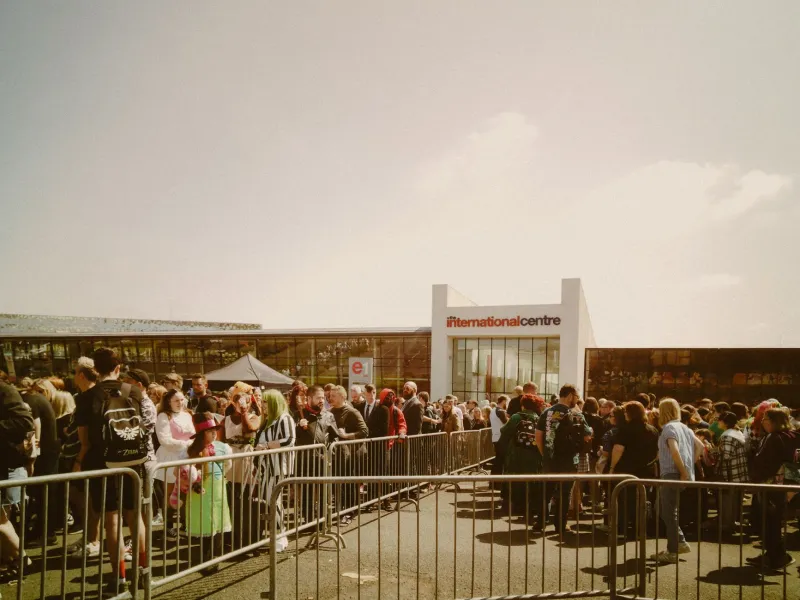
If you wanted to design the perfect conditions for an accidental creative collision, you might come up with something like this: take a cross-section of people who would never normally speak to each other, give them a shared mild grievance, remove all their usual distractions, and make it mildly impolite to look at your phone. Then wait.
You've just described a British queue.
It's a cultural institution so deeply embedded that we've stopped noticing how genuinely strange it is. In most of the world, waiting for something is a chaotic, competitive, every-person-for-themselves affair. In Britain, it's a choreographed social ritual with its own etiquette, its own hierarchy, and — this is the bit that doesn't get enough attention — its own surprisingly fertile conversational culture.
The Queue as Social Leveller
There's something about the queue that strips away the usual social architecture. In an office, in a pub, at a dinner party, you largely talk to people from your own world — your profession, your class, your neighbourhood. The queue doesn't care about any of that. It cares only about order of arrival.
The result is a form of enforced social mixing that's genuinely unusual in British life. The retired headteacher stands behind the twenty-three-year-old logistics coordinator. The GP queues behind the plumber. The software developer behind the primary school teacher. And because they're all mildly bored and slightly impatient and it would be odd not to, they start talking.
These conversations are rarely deep. They're often complaints. They're frequently about the queue itself. But occasionally — more often than you'd think — they're something else entirely.
The Complaint That Became a Product
The history of British retail design contains a number of innovations that trace their origins, at least partially, to what customers said while waiting. The concept of the supermarket express lane — now so standard that it's hard to imagine its absence — emerged partly from feedback gathered informally from customers in checkout queues who articulated, in various colourful ways, the absurdity of waiting fifteen minutes to buy a pint of milk behind someone doing a full weekly shop.
More recently, the entire architecture of click-and-collect services in UK retail was shaped significantly by complaints overheard and gathered in queues. The insight that customers were willing to do more of the logistical work themselves if it meant avoiding the queue — rather than just shortening the queue — was not an obvious one. It emerged from listening carefully to what people actually said while standing in them.
Think about the self-checkout machine, now a fixture of every major British supermarket. The path from concept to implementation was shaped at multiple points by queue-based feedback: complaints about slow cashiers, observations about which items people felt comfortable scanning themselves, grumbles about the bagging area that became, improbably, one of the defining comedic grievances of early twenty-first century British life.
Waiting Rooms and Waiting Lists
The NHS waiting room is perhaps the most concentrated version of the queuing phenomenon in British life. It combines the enforced proximity of the standard queue with a shared vulnerability that tends to make people more open than usual. Patients waiting for appointments have, over the decades, been a remarkable source of informal feedback about what the health service does well and — more productively — what it does badly.
Some of the most significant changes to NHS patient communication in recent years have roots in exactly this kind of informal observation. The shift towards text message appointment reminders, for instance, followed years of anecdotal evidence gathered partly from conversations in waiting rooms about how people actually managed their schedules and why they missed appointments. The waiting room, for all its institutional grimness, was functioning as a continuous focus group that nobody had officially convened.
GPs and practice managers who listened — really listened — to what patients said to each other and to receptionists while waiting found themselves with a remarkably accurate picture of what the system was getting wrong. The challenge was always institutional: how do you feed informal queue intelligence into a formal improvement process?
The Bus Stop Brainstorm
Britain's bus stops deserve their own entry in the national innovation register. The bus stop queue has particular properties that make it especially generative: it's long enough for a proper conversation, it's outdoors (which seems to loosen people up slightly), and the shared experience of waiting for something that may or may not arrive on schedule creates a particular flavour of resigned camaraderie.
Urban planners in several British cities have, in recent years, started paying much more deliberate attention to what happens at bus stops — not just the mechanics of boarding and alighting, but the social interactions that occur during the wait. Some of the most thoughtful recent thinking about urban public space in the UK has been influenced by close observation of bus stop behaviour: how people cluster, how they use the space, what they talk about, what they need that they're clearly not getting.
Transport for London's gradual evolution of its real-time information displays — those boards that tell you the 43 is four minutes away — was informed significantly by what commuters said to each other and to inspectors while waiting. The insight that 'four minutes' is psychologically very different from 'due' (even when they mean the same thing) came partly from listening to how people talked about uncertainty while standing in queues.
The Genius of Enforced Patience
There's a cognitive dimension to this worth exploring. The queue imposes a particular mental state that's surprisingly conducive to lateral thinking. You're alert enough to have ideas, but not so focused on a specific task that you can't entertain tangential ones. Your phone is technically available but socially discouraged. You have nothing to do but wait and, occasionally, talk.
This is, neurologically speaking, quite close to the conditions that tend to produce creative insight. The 'default mode network' — the brain's activity during unfocused, mind-wandering states — is strongly associated with creative thinking and problem-solving. The queue, by removing the usual demands on focused attention, may actually be nudging people into a more generative cognitive state than they'd be in at their desks.
Britain's genius for queuing, in other words, might be inadvertently engineering the mental conditions for breakthrough thinking several times a day, for millions of people, in every high street and hospital and post office in the country.
The Overlooked Archive
The conversations that happen in British queues are almost entirely unrecorded. They happen, they produce their small sparks of connection and insight and complaint, and then they disappear. The woman in the queue at Boots who articulated perfectly why the loyalty card system was needlessly complicated; the man at the post office who described, in passing, a better way to organise the collection service — these voices vanish the moment the queue moves forward.
Some companies have started to take this more seriously, deploying everything from ethnographic researchers to AI-assisted feedback tools to try to capture what queue culture produces. But the queue's value is also partly in its informality — the moment it becomes a focus group, it stops being a queue.
Perhaps the most honest thing to say is this: Britain has, for centuries, been running a continuous, unmoderated, entirely accidental national ideas session in its post offices and supermarkets and bus stops. The results have shaped more of modern British life than anyone has properly acknowledged.
The queue, it turns out, is not just a place to wait. It's a place where the next idea is already forming, somewhere between the third person and the fourth.