The Linoleum Laboratory: What Britain's Village Halls Know About Genius That Nobody Writes Down
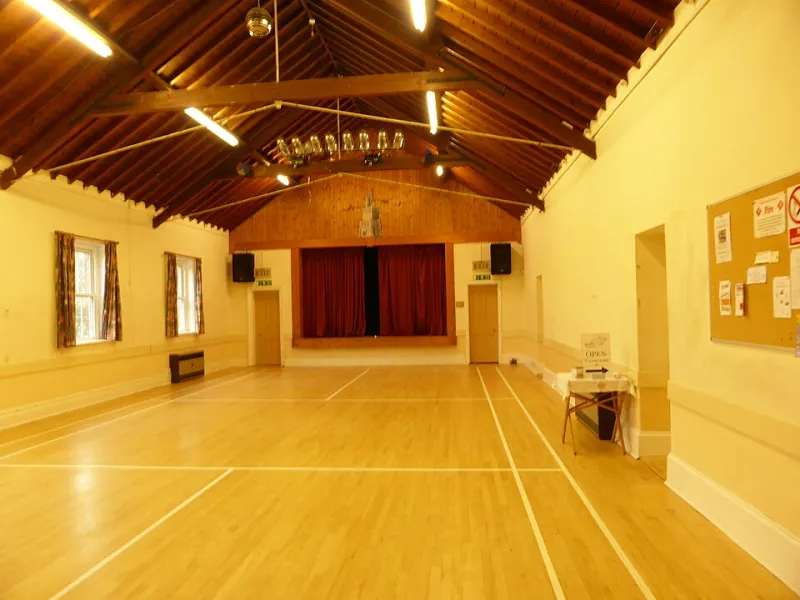
Photo: Bob Harvey , CC BY-SA 2.0, via Wikimedia Commons
Half past seven on a Tuesday in November. The key turns in a lock that has been sticking since the seventies, the strip lights stutter into life, and a hall somewhere in England fills with the smell of floor polish and other people's coats. By twenty to eight there are fourteen people, two trestle tables, a plastic box of cake, and a man called Dave explaining why the fuse keeps blowing.
This is not where anyone expects the future to be built. And yet.
The least fashionable room in the country
Village halls and community centres occupy a strange place in the national imagination: we all know one, almost nobody romanticises them, and they turn up in the background of every second episode of a Sunday-night drama. They are the rooms where jumble sales happen, where the parish council argues about parking, where somebody's aunt does a surprisingly good tap routine in a pantomime.
They are also, quietly, where a lot of things begin. Not the polished, funded, incubator-with-a-coffee-machine kind of beginning. The other kind: the scrappy, unphotogenic, we'll-see-how-it-goes kind.
Cheap rent is an underrated creative technology
Do the sums. A village hall might cost a tenner an hour, sometimes less for a regular booking, sometimes nothing at all if you're the one who sets out the chairs. Compare that to a co-working desk, a studio, a workshop with a proper licence and a landlord who wants a business plan.
The effect is not simply financial. It is psychological. When the overheads are almost nil, failure loses its teeth. You can run a bad evening in October, shrug, and be back in the same room in November with a different idea. There is no pitch deck to rewrite, no investor to disappoint, no quarterly review. The cost of trying something stupid is roughly the price of a bag of tea bags and a packet of custard creams.
That low-stakes loop — try, flop, try again — is precisely the mechanism that formal innovation programmes spend millions trying to manufacture. Here it happens because the room is cheap and nobody is watching.
The kitchen is the R&D department
Ask anyone who runs a hall what actually goes on and they will tell you the same thing: the interesting conversations happen at the sink.
Washing up is Britain's great social mixer. The model engineering club is rinsing a mug next to the woman from the repair café; the amateur radio lot are arguing about aerials with somebody's dad from the ukulele group; a teenager from the coding club is explaining to a retired joiner why the wifi drops out in the back room. Nobody has scheduled this. Nobody would have scheduled this. It is the accidental byproduct of putting unrelated people in one building with one kettle.
Cross-pollination is a tired phrase in innovation writing, but it usually describes a conference with name badges. In a hall it is genuinely accidental, and it is genuinely cross: the beekeepers know about the allotment society's drainage problem; the drama group's set-builder turns out to be the person who can weld the thing the men's shed has been stuck on since March.
Forced proximity, gently applied
There is another ingredient, less flattering to the myth of the lone genius: you cannot avoid each other.
In a hall, the badminton court shares an entrance with the history society. The book group stacks its chairs against the same wall as the food bank. The toddler group's toys are in the cupboard under the stage where the youth theatre rehearses. Everybody sees everybody else's mess, everybody has an opinion about the heating, and everybody has to negotiate the same diary.
That mild, unavoidable friction is a feature. It produces compromise, borrowed skills, and the strange hybrid projects that nobody would have proposed in a meeting — the seed swap that becomes a plant clinic, the coffee morning that becomes a warm hub, the amateur dramatics society that ends up building its own lighting rig because the hire quote was absurd.
Nothing to prove, which is the whole point
Perhaps the most underrated thing about a hall is the absence of a scoreboard. There is no valuation, no follower count, no growth target. The only metric is whether people come back next week.
Amateur status gets a bad press in Britain, as though it were a polite word for not serious. In practice it is a protective shell. Ideas that would be killed by a business case survive here because nobody is asking for one. The odd, slow, unmarketable thing gets another six months to become interesting.
The 2026 problem: the urn is not free
The trouble is that this whole system rests on buildings that are getting harder to keep open. Energy bills, insurance premiums, roof repairs, and the slow ageing of the volunteer committees that hold it all together — hall trustees up and down the country will tell you the same story over a digestive biscuit. Some rooms have been listed as Assets of Community Value to slow the slide. Some have been taken into community ownership. Many have simply closed, and the groups that used them have scattered into church porches and, eventually, nothing.
When a hall goes, the loss is usually described in terms of the groups that met there. That is only half of it. What actually vanishes is the middle ground between the kitchen table and the institution — the place where a half-formed idea can rent a room for twelve quid and find out whether anyone else cares.
What the linoleum knows
Genius, in this country at least, has a habit of turning up in buildings with a floor that squeaks. Not because there is anything magical in the parquet, but because the conditions are right: cheap, social, unhurried, and slightly uncomfortable.
So next time you pass a hall with a hand-painted sign and a wheelie bin full of folding tables, look twice. Somewhere inside, someone is failing at something for the second month running. That is usually how it starts.