10p a Go: The Seaside Arcades Where British Kids Learned to Code Before Anybody Called It Coding
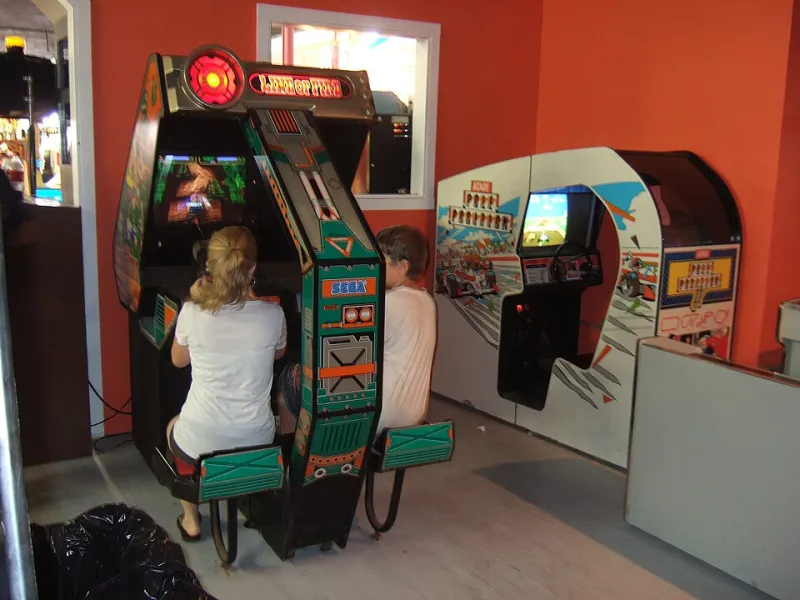
Photo: Rob DiCaterino from Jersey City, NJ, USA, CC BY 2.0, via Wikimedia Commons
You can still smell it if you try. Hot fat from the fryer next door, wet anoraks, ozone off the sea, and the faint electrical tang of a cabinet that has been running since opening time. Ten pence in the slot, a clunk, a countdown, and a screen that asks you to be better than you were a minute ago.
Seaside arcades were not designed to be educational. They were designed to take your money, and they were extremely good at it. But somewhere in the noise and the sticky carpet, a lot of British children had their first real conversation with a computer.
The machine that talked back
There is a difference between watching television and playing a game. One is a story being told at you; the other is a system with rules, and rules can be learned, exploited and broken. A generation discovered this on rainy afternoons in Blackpool, Rhyl, Great Yarmouth and Southend, feeding coins into cabinets with names that promised the world: invaders, asteroids, ghosts to be chased, cars to be overtaken.
What those machines taught was not programming exactly. It was something more foundational: the assumption that a machine's behaviour is knowable. If you die, it is not bad luck. It is because the pattern repeats, and you mistimed it, and next time you can do better. That is a startlingly adult idea to hand to a nine-year-old.
The backroom economy
Alongside the arcades ran a second, scruffier circuit. Chip shops and cafés with a machine in the corner. Leisure centres with a cabinet by the fire doors. Somewhere above a shop, a room with a fruit machine, a football table and a Space Invaders clone with a faded screen.
By the early eighties, the same kids were going home to something even more interesting. Home computers arrived in Britain at prices that felt — just about — reachable, and they were not sealed boxes. You could type at them. You could make them do things badly, and then slightly less badly, and then something nobody had seen before.
The magazine racks helped. Publications printed full game listings for anyone to copy out, line by agonising line, and a mistyped character meant the whole thing failed and you learned to debug by eye, at eleven o'clock at night, while the tape deck whirred. Later came cover-mounted cassettes, a distribution channel so cheap and so chaotic that it accidentally produced a national industry of teenagers posting games in Jiffy bags.
From the pier to the bedroom
The connection between the two worlds was not formal. Nobody sat down and wrote a strategy linking seaside amusement to a domestic software boom. But the appetites lined up perfectly: arcades had already established that a game could be a thing you admired, wanted to understand, and eventually wanted to make yourself.
The result was a British games scene with an unusual accent. Cheap, fast, funny, cheerfully crude. Games made by two people in a bedroom, sold by mail order, reviewed in magazines written by people who were basically the same age. It was less an industry than a very energetic amateur scene that occasionally made money — and it grew fast, before collapsing in a way that is now practically a case study in how quickly a boom can go sour.
What the seaside did that a classroom couldn't
Seaside towns have had a hard few decades. The week-long holiday went abroad, the piers got expensive to repair, and the amusement trade consolidated into something smaller and more nostalgic. The arcade that once held forty cabinets now holds a dozen and a claw machine, and the seafront behind it is full of flats.
But what those rooms did is worth naming. They put children in front of technology without an adult supervising the lesson. There was no curriculum, no assessment, no half-term report. There was a queue, a coin, and a system that was completely indifferent to your feelings. That combination taught persistence, observation and a certain cheerful disrespect for how things are supposed to work — the exact temperament you need to open up a machine and see whether you can make it do something else.
Why the DIY spirit still matters in 2026
We are, once again, in a period where technology arrives as a sealed box and a subscription. Tools are more powerful than ever and less visible than ever. The temptation is to consume, not to tinker.
Which is why the arcade spirit — find the cheap machine, learn its rules, bend them, make something scrappy and share it — is worth holding onto. You can see its descendants everywhere: in retro arcades along the coast, in repair cafés, in library coding clubs, in the people who buy a second-hand console specifically to take it apart.
None of it needs a pier. It just needs the willingness to put a coin in the slot and see what happens when you press the buttons in a different order.