Spill It: Nine British Blunders That Accidentally Changed Everything
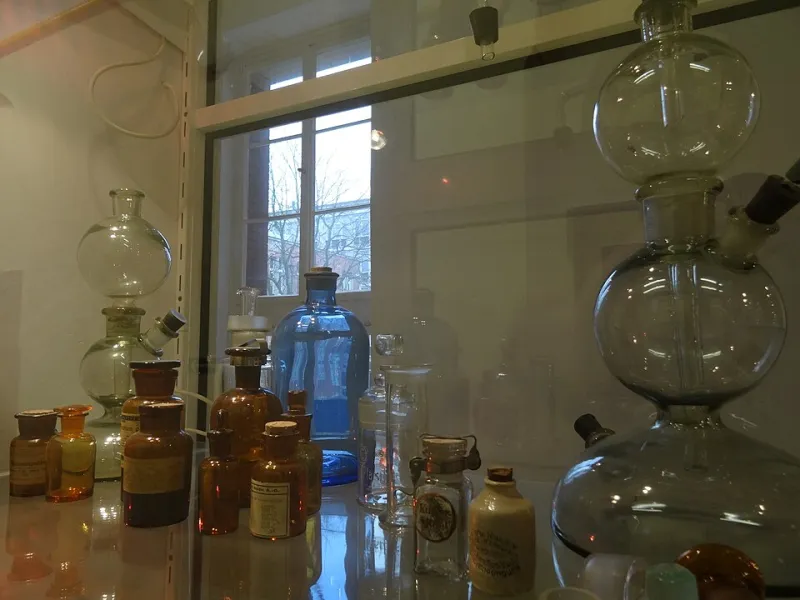
Photo: LukaszKatlewa, CC BY 4.0, via Wikimedia Commons
We love a tidy origin story: the lone genius, the flash of insight, the patent. The truth is messier, funnier, and much more British. Some of the most consequential discoveries made on these islands arrived through spilled liquids, crossed wires and somebody failing to clean up properly. Here are nine of the best — and a case for treating serendipity as a skill worth protecting.
9. The Sticky Note That Nearly Wasn't
When 3M's Spencer Silver cooked up a weak adhesive nobody wanted, it took Art Fry's hymn-book bookmarks to rescue it — proof that a "failed" glue can stick around in history anyway. Britain's research culture, with its tolerance for odd results, has always been fertile ground for this kind of salvage.
8. The Microwave Melt
Radar engineer Percy Spencer noticed a chocolate bar melting in his pocket near a magnetron. The microwave oven followed. British radar labs had been living alongside this physics for years — sometimes the discovery is just noticing your lunch.
7. Penicillin's Untidy Petri Dish
The most famous blunder of all. Alexander Fleming returned from holiday to find mould contaminating his staphylococci cultures — and a clear ring where bacteria refused to grow. A tidier scientist would have binned it. Fleming, characteristically, looked closer. Millions of lives later, we're still grateful for his housekeeping.
6. The Safety Glass That Survived the Drop
After a glass flask knocked from a bench refused to shatter — it had been coated with cellulose nitrate residue — laminated safety glass was born. Windscreen everywhere owe their existence to a clumsy moment and a curious mind.
5. Vulcanised Luck
Charles Goodyear's years of rubber failures ended, by legend, with a spill onto a hot stove. The rubber didn't melt; it transformed. Tyres, seals and half of modern industry followed from a dropped blob.
4. The Misread That Mapped the Deep
Oceanographers chasing supposed signals in their instruments repeatedly found "errors" in their readings — errors that turned out to reveal real features of the seafloor, reshaping our picture of the ocean bed. Sometimes the machine is right and the assumption is wrong.
3. Post-it Physics in the Print Shop
Countless printing and coating innovations arrived when inks behaved badly — spreading, beading or refusing to dry in ways that revealed new surface science. The lab notebook margins of British printing firms are full of accidents that became patents.
2. The Annoying Hum That Became Ultrasound's Cousin
Engineers troubleshooting noise in equipment have repeatedly stumbled on phenomena worth keeping — vibrations and resonances that, once investigated rather than suppressed, found medical and industrial uses. The lesson: never silence an anomaly before you understand it.
1. The Spill That Started a Discipline
And at the top, the humblest of all: the stained, cross-contaminated, mislabelled experiments that opened entirely new fields because someone chose curiosity over the bin. Every one of these stories shares a pattern — the mistake happens, and then a person notices.
The Real Point
Serendipity isn't magic. It's a system property: it requires freedom to fail, time to look again, and a culture that treats an anomaly as a question rather than an inconvenience. Britain has produced a remarkable number of happy accidents not because we're luckier, but because we've occasionally built the conditions for luck to land.
Protect the messy benches. Fund the odd results. And whatever you do — don't tidy the lab.