Filed and Forgotten: Britain's Patent Archive Is a Graveyard of the Future
Filed and Forgotten: Britain's Patent Archive Is a Graveyard of the Future
Patent offices are not, by reputation, hotbeds of imagination. They are places of forms and fees, of prior art searches and legal disputes, of carefully worded claims and cautious institutional language. They are, in short, the opposite of the messy, intuitive, occasionally deranged process by which actual invention happens.
And yet, if you know where to look, Britain's patent archive is one of the most extraordinary collections of human foresight on the planet. It is also, depending on your perspective, one of the most heartbreaking — a filing cabinet of the future, organised by rejection date.
Here are some of the ideas that got away.
The Victorian Who Imagined Wireless Everything
In the 1880s, the British patent system was processing a remarkable volume of applications from inventors convinced that electricity was about to transform everything. Most of them were right. A small number were right in ways that nobody around them could quite process.
Among this latter group was an engineer — records are incomplete, names sometimes ambiguous in digitised Victorian archives — who submitted a patent application describing a system for transmitting information "through the ether without the intermediary of wire or physical connection," using modulated electromagnetic signals that could be received by appropriately tuned apparatus at a distance.
The examiner's notes, preserved in the archive, are a masterclass in polite dismissal. The proposal was described as "theoretically intriguing but practically without foundation," and the application was declined on the basis that the underlying mechanism was undemonstrated. The applicant, apparently undeterred, resubmitted a modified version two years later. That one was also declined.
Marconi's wireless telegraphy patents began arriving at the British office less than fifteen years later. The examiner who processed them was, presumably, a different person.
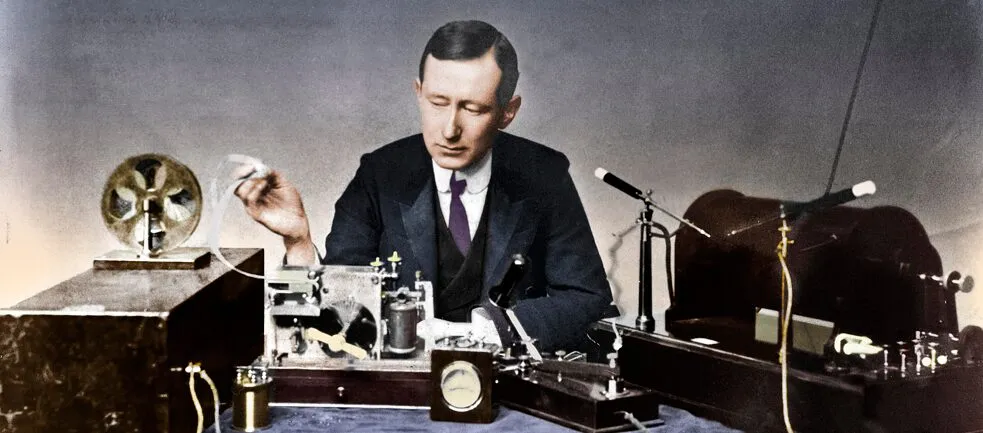 Photo: Marconi, via www.goethe.de
What makes the Victorian proposal particularly striking, reading it now, is not just the wireless transmission concept — which Marconi and others were circling at roughly the same time — but the specific language around modulation and tuning. The applicant had intuited, without the mathematics to prove it, that the key to useful wireless communication was not simply broadcasting a signal but controlling its frequency. That insight took the rest of the field another decade to formalise.
The 1960s Application That Touched the Future
The post-war decades were a fertile period for British invention and an equally fertile period for British institutional scepticism. The patent office during the 1960s was processing applications from engineers working at the edges of computing, materials science, and electronics — fields that were moving so fast that even experts struggled to evaluate what was plausible.
In this environment, a 1960s application describing an interface system for computing devices that relied on direct physical contact with a display surface — the user touching the screen itself to issue commands — was assessed and rejected. The examiner's reasoning was practical rather than dismissive: no display technology of the era could detect pressure or contact with sufficient sensitivity to make such a system workable, and the application was therefore premature.
The examiner was, strictly speaking, correct. The technology to make touchscreens functional didn't exist yet. What the examiner perhaps underweighted was whether a premature application could still establish a conceptual claim worth protecting.
Touch-sensitive interfaces began appearing in research contexts in the 1970s. Commercial touchscreens arrived in the 1980s. By the time the iPhone launched in 2007, the underlying patent landscape had been contested, litigated, and negotiated for decades — with various parties claiming various forms of priority. The 1960s British application, had it been granted and properly maintained, might have sat somewhere near the root of that family tree.
Instead, it sits in the archive. Filed. Forgotten. Entirely correct.
The Acoustic Proposal That Preceded Noise-Cancelling by Fifty Years
In the 1930s, a British engineer with a background in acoustics and a particular interest in the noise problems created by industrial machinery submitted a patent application describing a method for reducing unwanted sound by generating a secondary sound wave that was precisely inverted relative to the original — what we would now recognise as active noise cancellation.
The application was declined. The mathematics were sound, the examiner acknowledged, but the practical implementation required signal processing capabilities that simply did not exist. To generate an inverted wave in real time, you needed to be able to analyse the incoming sound, compute its inverse, and produce the cancelling signal faster than the original wave could be perceived. In the 1930s, that was not possible.
The engineer filed a note with his rejected application expressing confidence that the necessary technology would eventually arrive. He was right. Active noise cancellation became technically feasible in the 1950s and 1960s as electronic signal processing developed, and commercial noise-cancelling headphones began appearing in aviation contexts in the 1980s. The technology is now in hundreds of millions of consumer devices worldwide.
The original British application is dated 1933. Bose's foundational noise-cancellation patents are dated 1986. Fifty-three years is a long time to be ahead of the curve.
 Photo: Bose, via d1aeri3ty3izns.cloudfront.net
Why Britain Keeps Doing This
There is a pattern here that goes beyond individual bad luck. Britain has, across its industrial and technological history, produced a remarkable number of inventors who were genuinely ahead of their time — and a patent system that was, by design, not equipped to deal with them.
Patent law operates on demonstration. You must show that your invention works, not merely that it could work given technologies that don't yet exist. This is a reasonable requirement for a system designed to protect functioning inventions, but it systematically disadvantages the most visionary applicants — the ones whose ideas are so far ahead of available materials and components that proof of concept is simply impossible.
The result, across two centuries of British patent history, is an archive that reads like a catalogue of futures that arrived late. The ideas were there. The infrastructure to realise them wasn't. By the time it was, the original applications had expired, the inventors had died or moved on, and the credit had migrated elsewhere.
The Archive Awaits
The UK Intellectual Property Office holds records stretching back to the early nineteenth century. Digitisation efforts have made significant portions of this archive searchable, but systematic analysis of rejected applications — specifically, applications that were declined not because the idea was wrong but because the technology to implement it didn't yet exist — has barely begun.
There are almost certainly more stories in there. More Victorian engineers who imagined wireless networks. More mid-century inventors who sketched the outlines of technologies we now take entirely for granted. More applicants who were told, politely but firmly, that they'd arrived at the wrong time.
They had, of course. They'd arrived too early. Which, in the long run, is a very different thing from being wrong.