The 7:42 Think Tank: How Britain's Rail Commuters Keep Solving the Unsolvable

The 7:42 Think Tank: How Britain's Rail Commuters Keep Solving the Unsolvable
Britain's trains are not, by any objective measure, a premium thinking environment. The seats are frequently uncomfortable. The wifi drops somewhere between Didcot and Swindon without fail. The person across the aisle is eating something that smells aggressively of egg. And yet, against all reasonable odds, the British rail network has functioned for nearly two centuries as one of the country's most reliably productive intellectual spaces.
This is not a coincidence. It is, according to a growing body of psychological research and a rather wonderful collection of historical anecdotes, something close to a structural feature of how human cognition interacts with rhythmic, bounded movement. The train, it seems, is not just taking you somewhere. It is also doing something quietly remarkable to the part of your brain that solves problems.
Theorems on Ticket Stubs
The Victorian era gave us the modern rail network and, almost simultaneously, a generation of mathematicians and engineers who discovered that their best thinking happened somewhere between stations.
The mathematician and logician Augustus De Morgan — a figure not nearly famous enough given his influence on Boolean algebra and therefore every computer that has ever existed — was a committed rail traveller at a time when the Great Western Railway was still a novelty. Contemporaries noted that De Morgan had a habit of arriving at meetings with ideas he claimed to have "found" during the journey, as though the train had simply handed them over.
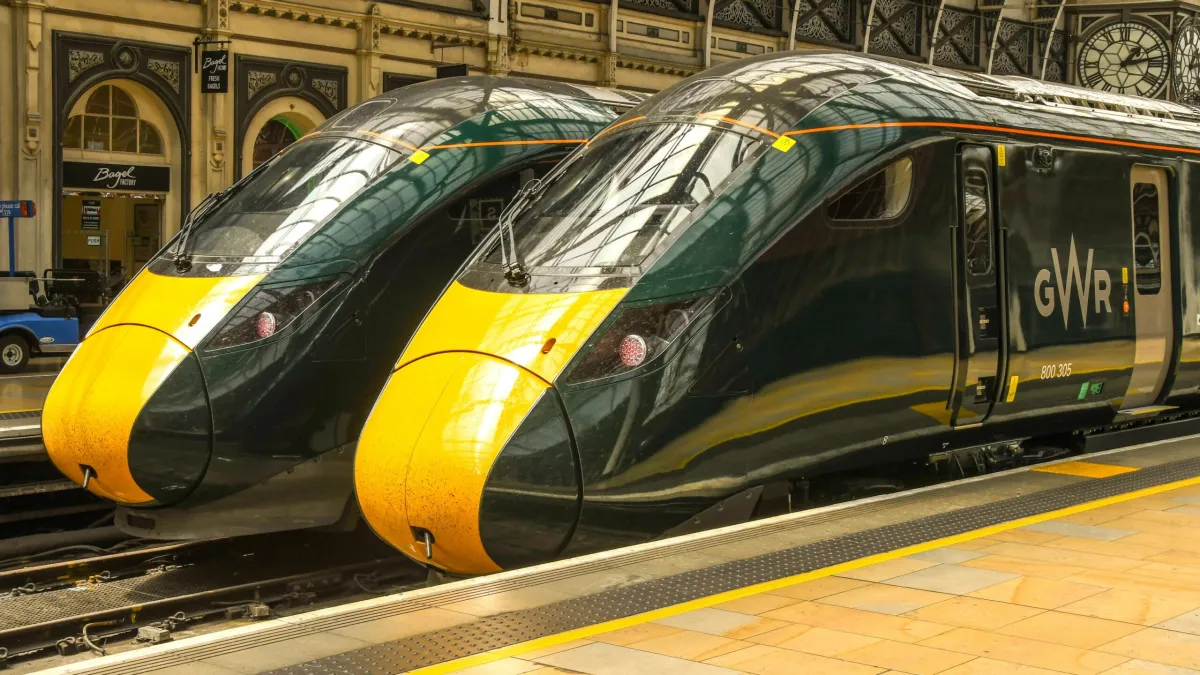 Photo: Great Western Railway, via www.londontravelwatch.org.uk
 Photo: Augustus De Morgan, via imgv2-1-f.scribdassets.com
He wasn't alone. The culture of Victorian intellectual life was deeply conversational — ideas were expected to circulate through letters, lectures, and club rooms — but the train introduced something different: enforced solitude within a social space. You were surrounded by people but insulated from them by convention. You had nothing to do but think. And the thinking, repeatedly, turned out to be surprisingly good.
Engineers working on the great Victorian infrastructure projects of the mid-nineteenth century documented solutions to structural problems that came to them during journeys on the very railways their solutions would eventually improve. There's a particular pleasure in that recursion — the train solving the problems of the train — that feels almost too neat to be true, and yet the records are there.
Why the Brain Likes a Rattling Carriage
Cognitive psychology has spent the last few decades trying to explain what the Victorians simply took for granted. The results are genuinely interesting.
The current understanding centres on what researchers call the "default mode network" — a collection of brain regions that activate not when you're focused on a task, but when you're not. Daydreaming, mind-wandering, idle reflection: these are all expressions of the default mode network doing its thing. And what it turns out to be doing, in those apparently unproductive moments, is making connections. Drawing lines between ideas that focused, task-directed attention would never have thought to link.
Train travel, particularly the rhythmic, visually undramatic kind that characterises so many British commutes, is almost perfectly calibrated to activate this mode. You're alert enough to be safe and conscious. You're bored enough that focused attention has nothing to grip. The gentle oscillation of the carriage, the predictable sequence of stations, the ambient noise at just the right frequency to mask distracting specifics — all of it conspires to push your brain into exactly the wandering state where unexpected connections get made.
The neuroscientist and author David Eagleman has described this phenomenon in terms of the brain's need for "incubation" — a period of apparently passive processing during which previously gathered information gets quietly reorganised. The train, by removing demands on active attention, creates ideal incubation conditions. You board with a problem. The problem percolates. You arrive with something that feels, suspiciously, like an answer.
 Photo: David Eagleman, via alliancefordecisioneducation.org
The Modern Carriage as Coding Environment
This is not merely historical. Speak to software developers, writers, architects, or scientists who commute by rail today and a remarkably consistent picture emerges.
Developers in particular have noted that debugging — the process of finding and fixing errors in code — often goes nowhere for hours at a desk, then resolves itself within twenty minutes of boarding a train. The explanation they offer, when pressed, is almost always the same: on the train, they're not staring at the screen. They're thinking about the code rather than at it. The distance, both physical and attentional, is apparently crucial.
One developer who commutes daily from Bristol to London described the experience as "enforced perspective." At a desk, he said, you're inside the problem. On the train, you're somehow outside it — able to see the shape of it rather than just the detail. That shift in vantage point, repeated five days a week for years, has produced solutions he's genuinely uncertain he'd have reached any other way.
Writers report something similar. The novelist and essayist Geoff Dyer once noted that train journeys had a way of producing sentences — not ideas exactly, but the specific verbal shape of ideas — that the desk environment resisted. The movement seemed to loosen something in the prose, to let it breathe.
The Commute as Creative Infrastructure
What's striking, looking across the history of British rail travel and the cognitive science that's slowly caught up with it, is that the commute has functioned as a kind of invisible creative infrastructure — unplanned, unremarked upon, but quietly essential.
The country has invested enormously in the physical infrastructure of rail: the lines, the rolling stock, the stations, the electrification projects that never quite get finished on schedule. But almost no attention has been paid to the cognitive infrastructure the network accidentally provides. The hours spent on trains across Britain every day represent an extraordinary collective thinking resource that nobody planned and nobody manages.
There is something very British about this. The most productive intellectual environment in the country turns out to be slightly damp, occasionally delayed, and staffed by someone apologising over the tannoy about a fault at Clapham Junction. Of course it is.
All Change
Next time your train sits inexplicably outside a station for six minutes while the driver "investigates a signalling issue," resist the urge to check your phone. Stare out of the window instead. Let the problem you've been carrying around all week float up from wherever you've been keeping it.
The Victorians who built this network didn't know they were building a thinking machine. But the evidence, across nearly two hundred years of eccentric, brilliant, rail-assisted insight, suggests that's exactly what they did.