Ink in the Margins: The Scrawling British Mathematicians Who Cracked the Impossible
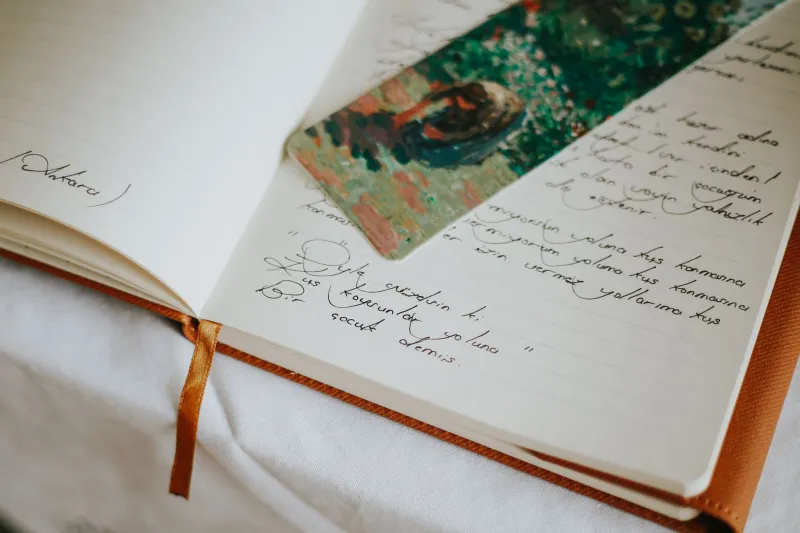
There's a particular kind of genius that refuses to wait for the right moment. It doesn't sit patiently at a mahogany desk, sharpen its pencil, and begin on line one of a fresh notebook. It grabs whatever's nearby — a napkin, a church programme, the edge of a crossword — and starts scrawling before the thought escapes. Britain, as it happens, has produced rather a lot of this kind of genius.
The myth of the formal breakthrough — the eureka moment in a gleaming laboratory, the revelation delivered in a tidy lecture hall — is one of the most persistent fictions in scientific history. The reality, if you look closely at the archive evidence, is considerably messier. And considerably more interesting.
The Art of the Accidental Notation
Mathematicians and scientists have long understood something that productivity gurus are only now catching up to: the brain doesn't switch into creative mode on command. It drifts there, sideways, during moments of apparent inattention. Doodling — that supposedly wasteful act of drawing spirals during a meeting or sketching triangles in the margins of a lecture handout — is now recognised by cognitive scientists as a form of active thinking. The hand keeps moving; the conscious mind relaxes its grip; and something underneath gets to work.
Britain's mathematical tradition is riddled with examples of this in practice. The margins of working papers held in university archives across the country tell a parallel story to the polished proofs published in journals. Scruffy, urgent, sometimes barely legible — but unmistakably alive.
Take the notebooks associated with the Cambridge Mathematical Tripos culture of the nineteenth century. Students and tutors alike filled the borders of their lecture notes with geometric sketches, half-formed conjectures, and notational experiments that never made it into the official record. Some of those throwaway sketches, examined retrospectively, contain ideas that wouldn't be formalised for another generation.
Hardy's Habits and the Margins of Collaboration
G.H. Hardy, one of Britain's most celebrated mathematicians, was famously dismissive of formal ceremony. His correspondence with Srinivasa Ramanujan — one of the most extraordinary intellectual partnerships in history — was conducted through letters dense with informal notation, crossed-out calculations, and marginal asides that read more like enthusiastic conversation than academic correspondence. Hardy himself admitted that some of his clearest thinking happened not at his desk but during long walks and in the idle moments between structured work.
What's striking, looking at the surviving letters, is how much of the real intellectual labour happened in exactly those informal scrawls. The neatly typed papers that followed were almost transcriptions — translations of a rougher, more instinctive language into one the journals would accept.
This pattern repeats across British scientific history with remarkable consistency.
The Newspaper Problem
There is a specific subcategory worth celebrating here: the problem solved on a newspaper. The British broadsheet, with its generous white borders and its cultural role as the thinking person's daily companion, has served as an unofficial mathematical scratch pad for well over a century.
Anecdotal evidence from mathematicians and physicists suggests that the particular texture of newsprint — slightly rough, slightly resistant — combined with the psychological permission that comes from writing on something disposable, creates an unusually productive thinking environment. You're not committing. You're just noodling. And in that noodling, something unlocks.
Several British physicists working in the mid-twentieth century reportedly kept a pencil tucked into their morning paper as a matter of habit. Not to do the crossword — though that happened too — but because the commute, the queue, the ten minutes before a meeting, were when the real problems got turned over and examined from unexpected angles.
Disorder as Method
What's philosophically interesting about all of this is what it says about the nature of problem-solving itself. Formal settings impose formal thinking. A blank page in a proper notebook carries a certain pressure — it expects to be filled with something worthwhile. A margin carries no such expectation. It's already subordinate to something else. Writing in it feels transgressive in the most minor, liberating way.
British mathematician and code-breaker Alan Turing was known for his idiosyncratic working style, filling papers with a mixture of formal notation and apparently random diagrams that colleagues sometimes struggled to interpret. His thinking moved fluidly between the rigorous and the speculative, and the physical evidence of that movement — the jottings, the crossings-out, the sudden detours — is part of what makes his archive so fascinating to study. The mess was the method.
What the Archives Are Telling Us
In recent years, historians of science have begun paying more systematic attention to this informal layer of the record. Projects digitising the working papers of British scientists and mathematicians have turned up a consistent pattern: the polished publication represents the end of a journey, but the margins document the actual route taken.
And the route is rarely straight. It zigzags, doubles back, takes peculiar detours through half-formed ideas that were abandoned and then, sometimes decades later, quietly picked up again by someone else who found the same margin in an archive box.
This is one of the reasons why the British tradition of keeping everything — the letters, the notebooks, the annotated offprints — matters so much. The margin isn't waste paper. It's the intellectual compost from which the next idea grows.
The Lesson in the Scrawl
There's something quietly radical about taking this seriously. It pushes back against the relentlessly optimised image of modern intellectual work — the clean desk, the structured thinking session, the productivity framework. It suggests that some of the best thinking happens precisely when we stop trying to think correctly and start thinking freely.
Britain's mathematical and scientific tradition has always had a slightly eccentric streak — a willingness to pursue ideas that seem unpromising, in settings that seem inappropriate, using methods that look, from the outside, like procrastination. The margin scrawlers understood something important: the impossible problem rarely yields to a frontal assault. You have to come at it sideways, pencil in hand, in the space nobody thought to police.
Next time someone catches you doodling in a meeting, you're in excellent company.