Return to Sender: The Lost Letters That Accidentally Lit Up British Science

There is something quietly magnificent about the British postal system — not its efficiency, which has always been a matter of spirited public debate, but its capacity for magnificent, world-altering failure. Across three centuries of intellectual correspondence, a remarkable pattern keeps surfacing: letters that never arrived where they were supposed to, yet somehow ended up exactly where they needed to be.
Think of it as accidental peer review. The universe, apparently, has occasionally found the Royal Mail more useful than the intended recipient.
The Victorian Detour
In the 1860s, scientific correspondence was the lifeblood of British intellectual progress. Journals were slow, conferences were expensive, and the fastest way to share a hypothesis was to post it. The problem, of course, was that Victorian postal infrastructure was considerably more optimistic than it was reliable.
Take the curious case of a bundle of papers dispatched from a naturalist in Edinburgh to a colleague in Oxford sometime around 1863. The bundle — containing detailed field observations about plant variation in Scottish coastal environments — went spectacularly astray and ended up delivered to an entirely different address in London. The recipient, a botanist with a completely different research focus, read the misdirected papers out of idle curiosity. What he found inside prompted him to revisit his own long-shelved work on seed dispersal, ultimately contributing to a paper that reframed how Victorian science understood coastal plant migration.
The Edinburgh naturalist never knew his lost letters had done anything at all. He simply assumed they'd been eaten by the postal system, which was not an uncommon assumption.
This kind of productive accident wasn't isolated. Historians of Victorian science have noted that the era's chaotic correspondence networks created what one academic memorably described as "a kind of intellectual cross-pollination that no journal editor could have planned." When letters went astray, they tended to land on desks already cluttered with adjacent problems — not because of magic, but because scientific communities clustered geographically and socially, meaning misdirected post rarely travelled far before finding another curious mind.
Wartime Censorship and the Serendipity of the Redacted Page
The Second World War introduced a new kind of postal chaos: deliberate interference. Censorship units across Britain intercepted, reviewed, and occasionally rerouted correspondence with a thoroughness that would have baffled Victorian postmasters. Most of this interference was, by design, destructive. But not always.
In at least one documented instance, a parcel of technical diagrams sent between two engineers working on separate government projects was intercepted, reviewed, and then — due to a clerical error at the censorship office — forwarded to a third party entirely. The recipient, an engineer working on a completely unrelated acoustic problem, recognised something in the diagrams that the original sender and intended recipient had both missed: a structural principle that he adapted for his own work on sound dampening in aircraft.
The original engineers eventually connected through proper channels and completed their project. But the accidental third recipient quietly published a small technical note the following year that drew on what he'd seen in those misdirected diagrams. It was a minor publication at the time. Decades later, researchers tracing the lineage of certain noise-reduction technologies found his note sitting unexpectedly near the root of the family tree.
Censorship, in that instance, had functioned as an involuntary editor — stripping context, removing the original sender's assumptions, and presenting raw technical information to a fresh set of eyes.
The Wrong Address, the Right Question
Not all productive postal failures were dramatic. Some were simply mundane mix-ups with outsized consequences.
During the early twentieth century, a mathematician at a provincial university posted a lengthy letter to a colleague outlining a problem he'd been wrestling with for months — a question involving the geometry of curved surfaces that he suspected had practical applications he couldn't quite identify. The letter went to the wrong department. A physicist who received it by mistake read it, couldn't make sense of why it had arrived on his desk, but found the underlying geometric question genuinely interesting.
He wrote back — not to the mathematician, whose return address he misread, but to another physicist he assumed must have sent it. That physicist, equally baffled, forwarded the letter on. By the time the correspondence had navigated its accidental relay race, three people who had never previously been in contact were exchanging ideas about curved geometry and its physical applications. The mathematician eventually traced his original letter through this improbable chain and found himself in the middle of a collaboration he'd never sought and couldn't have engineered.
The geometry question, incidentally, found its practical application. It just took a few wrong addresses to get there.
What the Chaos Was Actually Doing
It would be easy to romanticise all of this as proof that the universe nudges brilliant ideas toward their destiny. That's a lovely thought, but probably not the most useful frame.
What the history of lost scientific correspondence actually reveals is something more structural: that intellectual breakthroughs often depend less on the right conversation reaching its intended destination and more on any interesting conversation reaching someone curious enough to engage with it. The postal failures that mattered weren't random — they happened within communities of intellectually active people who read things that arrived on their desks because reading things was simply what they did.
In other words, the accidents worked because the culture was ready for them. Victorian and wartime Britain produced dense networks of correspondence precisely because scientific and technical communities understood that ideas needed circulation. When the circulation went wrong, there were enough active minds in the system to catch what fell out.
The Archive Nobody's Properly Searched
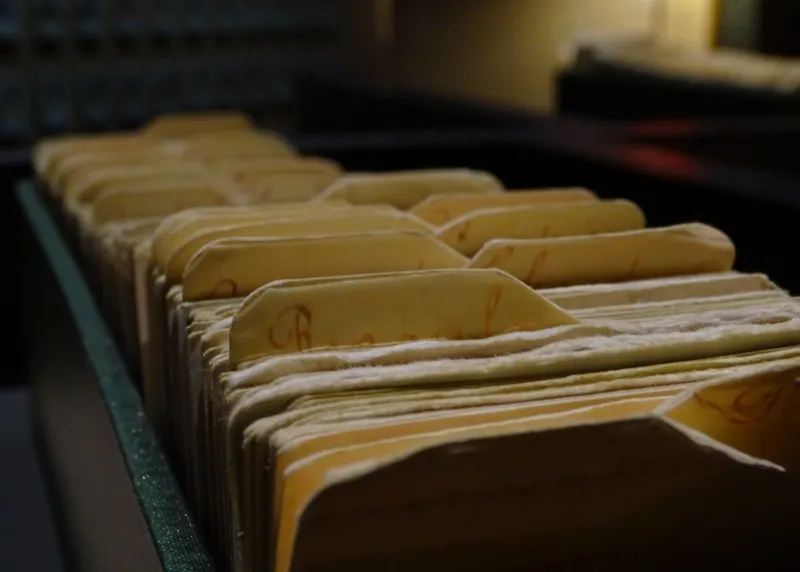
Here's what's genuinely exciting: historians of science have barely scratched the surface of this phenomenon. The British Postal Museum holds records that have never been systematically analysed for misdirected scientific correspondence. University archives contain letters filed under wrong names, wrong dates, wrong departments — administrative errors that have preserved accidental connections nobody has yet thought to trace.
 Photo: British Postal Museum, via c8.alamy.com
Somewhere in those files, almost certainly, are more stories like these. More misdirected envelopes that quietly rewired the intellectual landscape. More wrong addresses that turned out to be exactly right.
The genius, it seems, wasn't always in the sending. Sometimes it was entirely in the getting lost.