Under the Skin: How a Handful of Quietly Brilliant British Tattoo Artists Turned Sailor Ink into Something Extraordinary
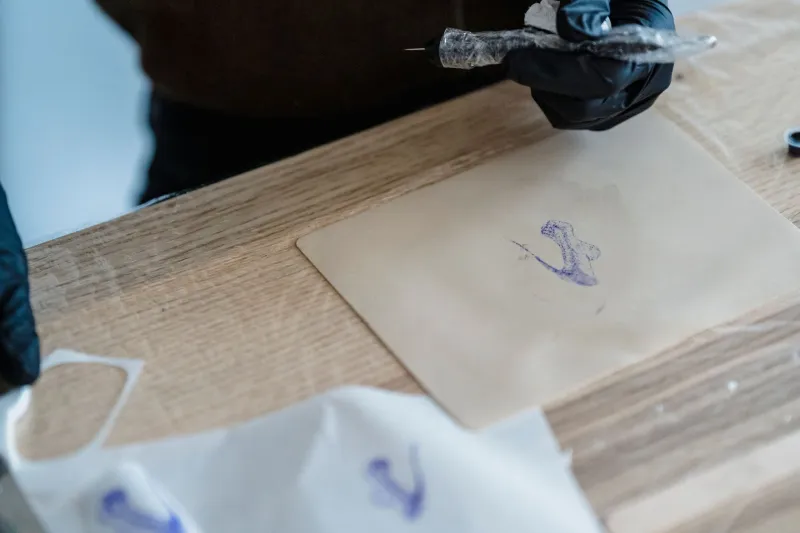
The parlour was above a chippy in Chatham, or down a side street in Portsmouth, or tucked behind a pub in Hartlepool. The sign was hand-painted, the portfolio was a battered folder of flash sheets pinned to the wall, and the clientele was almost exclusively male, almost exclusively working class, and almost exclusively there because they'd just come off a ship.
This was British tattooing for most of the twentieth century: hidden, practical, vernacular. A souvenir. A rite of passage. A conversation starter in the wrong pubs. Not art. Definitely not art.
Except — quietly, stubbornly, with no critical framework and no institutional support — it absolutely was.
The Dockyard Tradition
Britain's tattoo culture is older than most people realise. Sailors returning from the Pacific in the late eighteenth century brought the practice home, and by the Victorian era a thriving industry had established itself in port towns along the south coast, in the northeast, and along the Thames. The clientele was self-selecting: men who worked with their bodies, who lived with risk, who wanted a permanent mark of something that mattered.
The artists who served them were largely self-taught, working from designs that had been passed down, copied, adapted, and refined over generations. The aesthetic was immediately recognisable: bold outlines, limited colour palette, iconic imagery — anchors, roses, swallows, hearts, ships. It was a visual language as coherent and codified as any folk tradition.
What's remarkable, in retrospect, is how sophisticated that language actually was. The bold outlines weren't a limitation — they were a solution to the problem of longevity, ensuring designs remained legible as skin aged and shifted. The limited palette was a response to the available pigments, but it also produced an aesthetic clarity that graphic designers would later spend careers trying to replicate. The iconic imagery wasn't generic — it was a symbolic vocabulary with specific meanings understood by the community that used it.
This was a working design tradition, developed empirically over decades, with its own internal logic and its own standards of quality. It just didn't have a gallery.
Sutherland Macdonald and the Gentleman's Art
Not every early British tattooist worked the dockyard circuit. Sutherland Macdonald, operating from Jermyn Street in London in the 1890s, built a clientele that included aristocrats, military officers, and — allegedly — members of the royal family. He brought a different sensibility to the work: finer lines, more complex compositions, a willingness to treat the body as a genuinely pictorial surface.
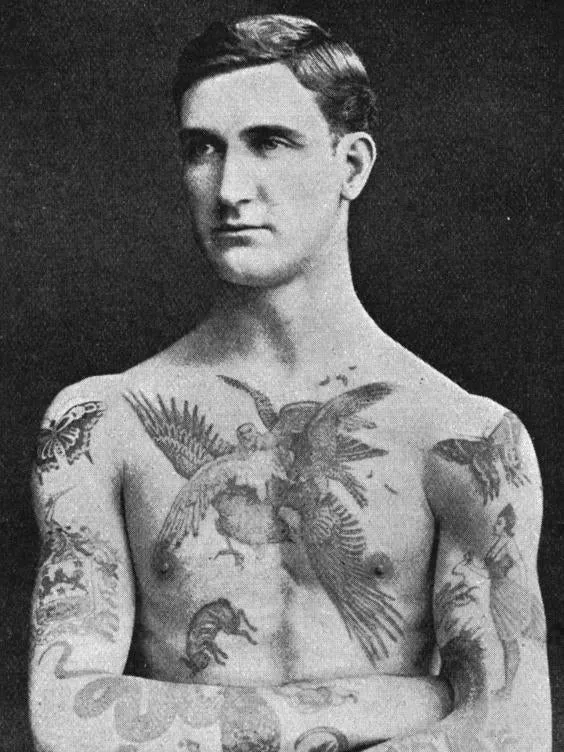 Photo: Sutherland Macdonald, via static.independent.co.uk
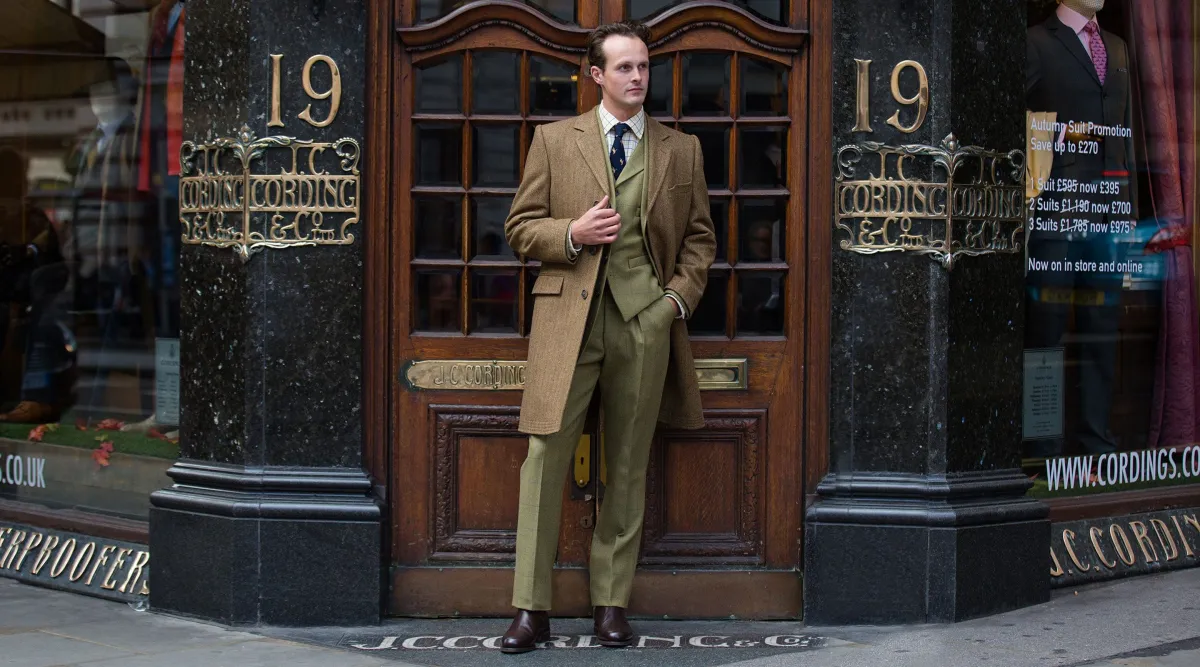 Photo: Jermyn Street, via luxurylondon.co.uk
Macdonald was exceptional, and his Jermyn Street premises were a world away from the Chatham chippy. But what he shared with his less celebrated counterparts was the core obsession: a belief that tattooing, done well, was a serious craft requiring serious attention. He developed his own pigment formulas, his own needle configurations, his own compositional approaches. He was, in the truest sense, a practitioner who was also a researcher.
The establishment never quite knew what to make of him. He was too skilled to dismiss, too associated with the working-class tradition to fully embrace. He occupied the same uncomfortable middle ground that British tattoo artists would inhabit for another century.
Colour Theory in a Backstreet Studio
By the mid-twentieth century, a new generation of British tattooists was pushing against the boundaries of the traditional flash aesthetic. Working in studios that had none of the resources available to fine artists — no formal training, no access to art historical discourse, no critical community — they were nonetheless developing sophisticated approaches to colour and form.
The problem of tattooing colour is genuinely complex. Pigments behave differently under skin than on paper or canvas. Light hits the surface in ways that alter perceived hue. The healing process changes everything. Getting colour to work — to remain vivid, to blend correctly, to hold its integrity over time — requires an understanding of optics, chemistry, and human biology that most practitioners arrived at through years of painful trial and error.
The artists who cracked it developed their knowledge empirically, sharing techniques within tight communities of practice, guarding innovations that represented years of work. It was, in the most literal sense, applied colour theory — developed without textbooks, without institutions, without any of the apparatus that usually surrounds serious artistic practice.
From Parlour to Gallery
The shift in tattooing's cultural status over the past thirty years has been genuinely startling. What was once definitively working-class and subcultural is now mainstream, expensive, and — in certain quarters — critically respected. Major galleries have begun acquiring tattoo-related works. Fashion houses have collaborated with tattoo artists. The techniques developed in backstreet studios have influenced illustrators, graphic designers, and fine artists in ways that are increasingly acknowledged.
Some of the artists who built the foundations of this tradition are still working. Many are not, and the knowledge they carried — the specific formulas, the hand-developed techniques, the oral traditions of the parlour — has in some cases been lost entirely. The documentation that exists is patchy, largely produced by enthusiasts rather than institutions, and has only recently begun to attract serious scholarly attention.
British tattoo culture is, in this sense, a case study in what happens to working-class creative traditions when there's no infrastructure to preserve them. The work was extraordinary. The framework for recognising it simply didn't exist.
What's Still Hiding in Plain Sight
The story of British tattooing raises a question that applies well beyond the parlour. How many other working-class creative practices are sitting just outside the frame of official cultural recognition — developing their own techniques, their own aesthetics, their own traditions — waiting for someone to look properly?
The genius wave doesn't always announce itself. Sometimes it's just a hand-painted sign above a chippy, and a practitioner who's spent thirty years figuring out how to make colour last.
Turn the frame a little. Look at what's been there all along.